A “God” I can Believe In

ManyGods“God” is a group of sounds often used in English. Those sounds have very different meanings to different people. But no matter what particular mutually-contradicting religion a person belongs to, when they say “I believe in God”, most people mean little more than exactly what I also believe. That usually mean something as innocent as:

  • a reflective life is valuable
  • attempts to lead a moral life are good
  • awe can be felt by looking at the world
  • it is important to look for peace and love
  • forgiveness, generosity and kindness should be nurtured
  • even when things are bad, we should try to find some good or inner peace
  • the patterns of relatedness in the universe are dazzling
  • we should sacrifice for our family and friends
  • we should not limit our kindness to only our loved ones
  • we should limit our pride and greed from harming others

The list goes on. For you see, God is huge — well, if that is what they mean by “G-o-d” or any equivalent. But if, by “God” they mean:

  • I can affect the health and well being of others by praying to Him/Her/It
  • He rewards those who believe in him and punishes non-believers
  • He is a being who wrote a book that tells us exactly what is right and wrong
  • My present life is more meaningful than yours because I believe in him and you don’t
  • History and my life is controlled by Him, so I should relax and just accept things.
  • We should not question what He tells us
  • I will preferentially associate and support with those who agree with my beliefs in Him only if they label them with my sounds and stories, otherwise I will avoid or fight them

Well, then, I don’t believe in their “God” (or whatever sound they use to label it) and will fight that particular belief.  Sure, I can believe in the first list but I have no need to try and tuck it all into one package and call it “God”.

But what if the sound “God” for them is a mix of items from both of those lists? Well, then I will try to fight the bottom list items (and any tools they use to strengthen them) and support the top list items and hope they do the same for me.

The question is, what do I do with the sounds “g-o-d” which they are attached to and can’t seem to understand how they are really using the word?  We could do the same analysis with the word “Freedom”, “Democracy”, “Family” and more, but let’s stick to “God” today.

13 Comments

Filed under Philosophy

Christians and Smiling Dogs: Belief vs. Religion

Smiling DogsThis morning I saw a glimpse of the similarity between a dog’s smile and the complexity of a believer’s heart. Dogs have a wide range of emotions and are very expressive using their ears, tails, fur and posture. I have raised many dogs over the years — often three at a time. But none of my dogs have ever shown the ability to smile. Some people feel dogs smile (see my notes below — there are lots of YouTube videos of supposedly smiling dogs).  Though none of my dogs have ever smiled, I can usually tell when my dog would be smiling if she or he could. To illustrate my point, here are picture of me petting my dogs when I know they are very happy and would smile if they could but as you can see: no hint of a smile.

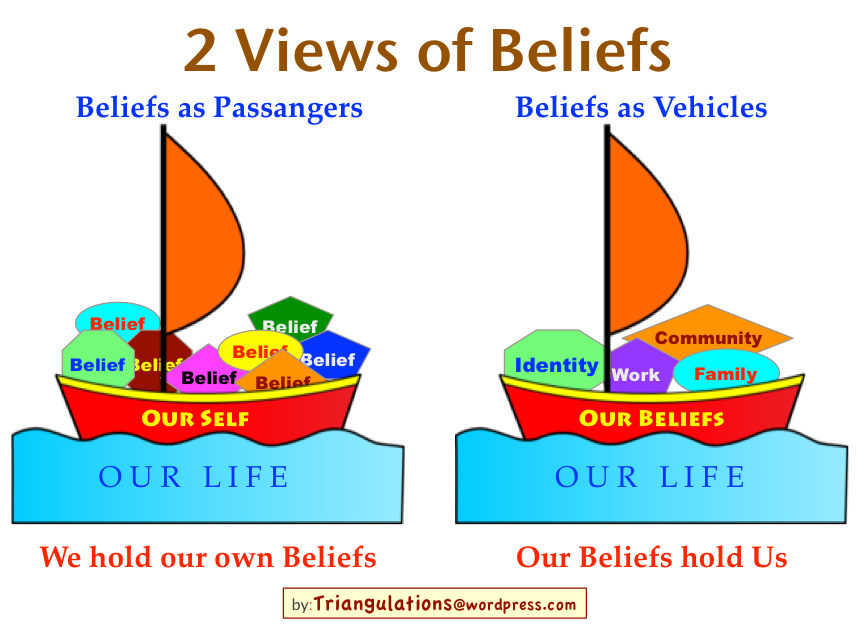
Many religions hold very pernicious beliefs that should be attacked but religion is far more than just a set of beliefs. Atheists sometimes criticize religion as if they were just a matter of professed doctrines. But this attitude toward religion reveals a misunderstanding of the deeper mechanics of belief. Sure, for some believers, “right belief” is what they tell us is critically important to their faith, but I think even those believers are mistaken.

Nonbelievers burning in  hell: painted on the dome of the Basilica in Florence.

Nonbelievers burning in hell: painted on the dome of the Basilica in Florence.

One of the pernicious beliefs held by many Christians is that non-believers will burn in hell for eternity. And though several of my friends attend denominations that proclaim such views, I know that my friends personally don’t believe it though they could never verbally tell me they did not believe it. For if they did, part of their mind would be lying. Religion is complex. But the religion of my friends is largely moral and social and not centered on belief. They can’t really say that they don’t believe I will burn in hell, because the mechanics of their faith won’t allow it just like the mechanics of my dogs won’t allow him to smile. But I know my real friends don’t really think I am going to hell at all, even though their theology wouldn’t allow them to verbalize it. They give away their deeper ecumenicalism in many other important ways. Sure, I wish they’d disavow the pernicious views of their church, but for now, I am glad they are my friends.

Mind you, I have many Christian acquaintances who actually do believe I am rightfully bound for hell, and they will stay acquaintances.

In my next post, I will give a very simple example of the mix of factors that enlivened my own former Christianity to illustrate how belief is only one small part of religion.

________

Notes on smiling dogs:

6 Comments

Filed under Religion

Ramayana faith in Mauritius

Mauritius Hindus

Mauritius Hindus

The seeds for my doubts in Christianity began during my travels among non-believers. I made a year-long hitchhike journey from Europe to India during which I often survived off the kindness of others — and those others were non-believers. Hearing their stories and seeing that their struggles, hopes and rationalizations were so very similar to mine began my unraveling realization that theologies and spirit-stories where coverings for both psychological and social phenomena and had nothing to do with the workings of magic spirit realms.

Though the magic of invented cosmologies slowly evaporated for me, the mystery and wonder of the human psyche and human relations only became deeper — but not only the wonderful side stood out, but also the dark side. Slavery is one of many practices on the very dark side of human history and continues today.

Mauritius

Mauritius

The outlawing of slavery has been slow:  it was outlawed in USA in 1865, earlier in France in 1848 and  a bit earlier in the British Empire in 1833. Nonetheless, before its demise, the British (and the French) had taken slaves from their colonies to many other lands. While studying the Ramayana (a holy text of Hinduism), I have learned how Hinduism (and devotion to the Ramayana) spread by the British export of Indian slaves to places like Fiji, Trinidad and Mauritius. This diaspora of Indians have been separated from their homeland for centuries but a devotional Hinduism still survives.

Mauritian is more than 1,000 miles off the east coast of Africa and was uninhabited when it was first discovered by Arab sailors in the Middle Ages. Mauritius was called “Isle de France” under the rule of the French East India Company (1715-1810) when the French brought Indian slaves to help built Port Louis.  When the Brits conquered the island in 1810, they brought Indian slaves to Mauritius to work their sugar-cane plantations.  The island nation is now a huge mix of ethnic groups. The largest ethnic group is Hindu at about 50%.

Today I read a post in “Le Mauricien” where a descendent of those Mauritian slaves describes the Hindu faith of his mother– please do consider giving it a quick read, if you have time. Reading his evaluation of religion and his insight into his mother’s faith reminded me of many of the insights I had which helped me to see behind my parochial Christianity and to see even further, into the workings of the human heart.

________

Notes:

2 Comments

Filed under Religion

Chaining up your loved ones

mentally ill in Bali, chained for decades (Spiegel)

Mentally ill in Bali, chained for decades (Spiegel)

I loved my vacation on the colorful Indonesian island of Bali. Hindu Bali contrasted starkly to the Muslim main island of Java. I spent two weeks on each, so my impressions are superficial and there is much you don’t see as a tourist.

Spiegel Online has a fantastic article exposing a dark side of Bali — its treatment of the mentally ill. Like many superstitious religions, Bali Hinduism considers mental illness to be caused by possession of evil spirits. The article describes one Bali psychiatrist’s efforts to combat the cruel chaining-up of mentally ill family members.  She tries to secure medicines, safer living quarters and teaches meditation (see this cool photo).

Sure, religious superstition in horrible but as I read the article, it becomes clear that the problem is far bigger than the Hindu belief in evil spirits — the core issue is poverty.  I imagine a large number of even naively superstitious believers in evil spirits would generally treat their supposed possessed family members much better if medications and treatment facilities were available.   They would rationalize to themselves using modern treatment even if part of their brains believed spirits were doing the damage.  So, if I had to choose improving religious stupidity or poverty, I would choose the later. Unfortunately, the two are often tied together.

I work in medicine in the USA where I also see very poor treatment of the mentally ill and the demented. The worse treatment tends to be among those who are poor. It is much easier to be gracious and kind when you aren’t struggling to survive. That is why the poor who love and care for their own stand out far above those with means.

4 Comments

Filed under Philosophy

The Pope’s Silly Saints

The Catholic Pope has just canonized 813 Italian Christians who refused forced conversions to Islam by Turkish Muslims in 1480. Yep, he magically transformed those poor souls into sainthood.

I wonder what his great Holiness thinks of the Pagans killed for not converting to Christianity under Theodosius I in the late 4th century. Or maybe present day Pagans could elect their own Popish leader to make saints of the 4,500 Germanic Pagans murdered by Charlemagne during his orders for forced conversions to Christianity.

The list goes on. The Medieval era saw much slaughtering of non-believers by the dear Church. The Spanish Inquisition in the 1400s saw Muslims and Jews tortured and slaughtered for not converting.  Consider the Jesuits (the Pope’s club) who in the 1500s tortured and killed Indian Hindus in the Goa Inquisition and destroyed their temples.

So, making saints of Christians who refused to convert to Islam is a joke.

5 Comments

Filed under Christianity, Hindu, Islam, Religion

Should Muslim apostates or adulterists be killed?

Somali woman 'rightfully' stoned to death for out-of-marriage sex under Sharia Law.  Pew survey shows

Somali woman legally stoned to death for out-of-marriage sex under Sharia Law.

I am a proud, though somewhat embarrassed, Christian apostate.  I once enthusiastically embraced Christianity but then ‘deconverted’.  My apostasy cost me my friends and some family, but it did not cost me my life.  Though Christians use to kill apostates, they no longer do.  But in many Islamic traditions, the penalty for deconverting (riddah) from Islam is death.  This recent Pew poll shows the horrible prevalence of this evil way in present-day Islam with percentages  of Muslims who agree with killing apostates.

  • 86% in Egypt
  • 82% in Palestinian territories
  • 46% in Lebanon

The same survey shows Muslim approval for stoning (execution) as punishment for adultery:

  • 89% in Pakistan
  • 85% in Afghanistan
  • 84% in Palestinian territory

At the hospitals where I work, after the Boston marathon bombing,  I have heard Muslim doctors arguing with colleagues that militant Islam is an exception — that Islam is actually a religion of peace.  And, indeed in my very limited experience, for Muslims I know here in my town, that is the case.  But for many Muslim’s I met in when I lived in Pakistan, that was not the case.  Look at the Pew data to see a very dangerous story for much of Islam.

After watching Massimo Pigliucci recent talk on morality, I wondered about the “apostate” meme and the classic “trolly” dilemma  I wonder if people who say they think apostates should be killed, would actually throw the stones needed to kill an apostate in front of them or if they are only comfortable with others killing apostates for them. That is why governments and religions are dangerous — we can make very different decision when we are removed from a situation then when we give over responsibility to a larger group which has been sanctified.  The kill-apostate meme is deadly and evil but the “apostate meme” itself is horrible and feeds this mentality.  The meme still exists in many forms of Christianity.  This meme must be combatted.  So take a stance — stand out — if possible, proudly declare your religion-free life so as to perhaps make apostasy safer for others.

—————————————

Now for a final linguistic treat:

Apostate” is from the Greek: “defection, desertion” – to stand away from

    • apo: away from, off
    • stenai: to stand

Other examples of “apo” words:

    • apology: apo + logos: speech. To speak in one’s defense
    • apocalypse: apo + calypso: hidden. to uncover, disclose
    • apogee: apo + gaia: earth. furthest from earth

Other examples of “stenai” words — from PIE: “sta”

    • station: a place to stand
    • statue: made to stand

7 Comments

Filed under Philosophy, Religion

Box Turtles

BoxTurtle

Box Turtles are so cool.  My kids and I have captured a few around our house.  We raised them for a short while, then let them go.  But I was very surprised to see this little fella on top of building where I was working.  I mean just sitting there peaceful near a large puddle of water.  Walking down a hall, I just happened to be looking out the window and there she was — a funny little box turtle far away from her home.

But then my head did a double-take and my eyes, as amazing as the human eye is, decided to focus in and examine. Scroll down to see what my eyes and brain presented to me next.

Oh how very deceptive is the human mind.  This, of course, has all sorts of implications not only in religion but also in science, relationships and much more.  For it is our mind that does all of that for us.  Alas!

I hope I have set up this post’s visuals well enough so that you may have experienced what I experienced.

Question to readers:  Share a story of when your eye-mind tricked you.
Here is what I saw after focusing, both my eye/mind and my camera:
Box_Turtle_Hospital_focus

6 Comments

Filed under Cognitive Science